
Old School Days Guess It
Every Old School Desk Had a Hole in the Corner. What Was It For?
Almost every surviving wooden school desk has a round recess cut into the top right corner. Here is what went in it, and why it stayed long after it stopped being used.

If you have ever seen a wooden school desk from the first half of the twentieth century — the sloped lid, the hinged top, the bench seat bolted to the frame — you will have seen the hole. It sits in the top right corner, about four centimetres across, neatly cut and often stained a dark blue-black around the rim.
It is one of those objects that thousands of people used every day and then completely forgot about within about fifteen years.
The clues are all on the desk
Three details give it away.
The first is the position. It is on the right, which suits a right-handed writer and tells you it relates to the act of writing rather than storage. In an era when left-handed children were frequently made to write with their right hand, nobody thought this was a problem worth solving.


The second is the long shallow groove running across the top edge of the lid. That is a pen rest. It exists because the desk lid slopes, and anything cylindrical placed on a slope rolls off.
The third is the staining. Look at any surviving desk and the wood around the recess is usually darker than the rest, in a rough circle, with drips running down the slope.

.jpg)
Why it stayed so long after it was useless
The answer below explains what went in the hole. The more interesting question is why the hole survived.
School furniture was built to last and bought rarely. A desk ordered in 1925 could still be in a classroom in 1975, by which time the object it was designed around had been obsolete for twenty years. The recess became a place to keep a rubber, a conker, a marble, or nothing at all — and that is how an entire generation sat at a desk built around a piece of equipment they had never used.
Reveal what it is
Answer It held a ceramic inkwell
The recess held a small ceramic or glass inkwell, which sat flush with the desktop so it could not be knocked over. Pupils wrote with a dip pen and a steel nib, and the well was refilled from a larger bottle, often by a pupil given the job for the week. The long groove along the top of the desk is part of the same system: it stopped the pen rolling off the sloped lid. Ballpoint pens became common in schools through the 1950s and 1960s and the inkwell fell out of use, but desks were expensive and lasted decades, so the hole outlived its purpose by a generation. Many surviving desks still have the ink stains around the recess, and some still have the well in place.
Where this came from
- Writing equipment and school furniture collections — Science Museum Group
- History of the ballpoint pen — National Museums Scotland (Background on the transition from dip pens to ballpoints in schools.)

Read next
 Countdown
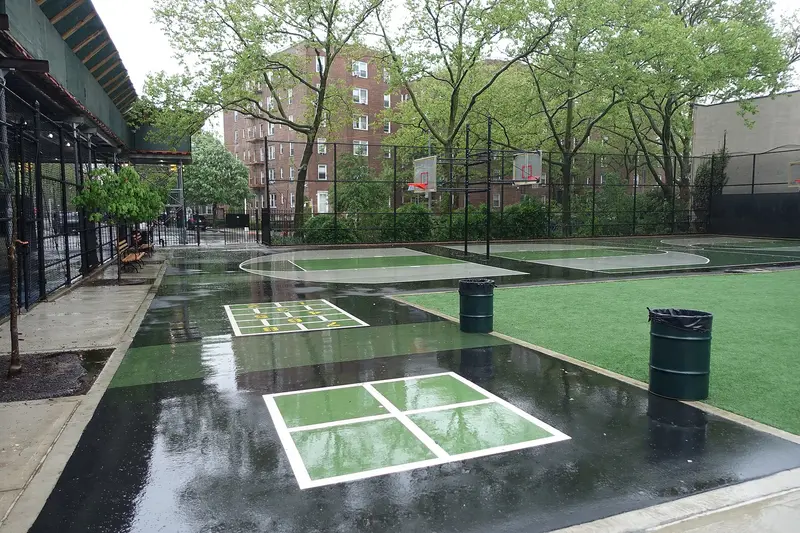
 Twelve Playground Rules That Every School Somehow Shared
Nobody wrote them down, nobody taught them, and yet children hundreds of miles apart played by the same rules. Twelve of them, and why they spread.
 Guess It
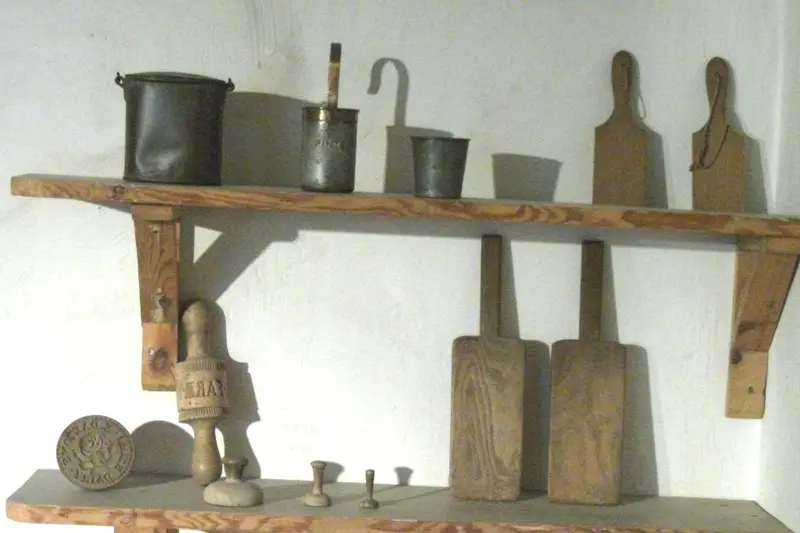
 There Is One in Almost Every Kitchen Drawer. What Was It Actually For?
A flat metal disc with a wooden handle and a rippled edge, found in kitchen drawers everywhere. Here is what it did, and the three objects people usually confuse it with.
 Countdown
 Fifteen Objects That Were in Every House and Are Now in Almost None
Not antiques. Ordinary things, so common that nobody photographed them, which is exactly why they are so hard to picture now.