
Memory Challenges Memory Challenge
Study This Shelf for Twenty Seconds, Then Answer Four Questions
A memory challenge where every answer is read straight from the scene data, so there is never an argument about what was actually shown.
Before you start, one thing worth saying plainly: this is a game. It is not a test of anything.
Memory challenges get dressed up online as screening tools for all sorts of conditions, which is both wrong and unkind. Performance on a twenty-second picture task depends on how you happened to look at it, whether you were interrupted, how tired you are and what you decided to pay attention to. It says nothing about your health.
With that out of the way, it is a genuinely good game.
How to play
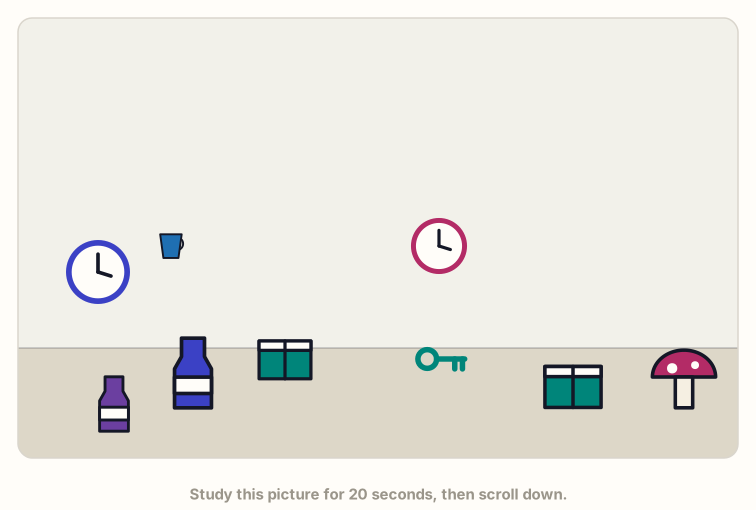
Look at the scene below for about twenty seconds. Do not write anything down.
Then scroll past it and open the reveal, which contains the questions and the answers together. Answer them in your head first, honestly, before reading each answer.
What actually helps
Most people look at a scene like this the way they look at a photograph: taking in the overall impression and remembering almost nothing specific.
The techniques that work are unglamorous. Counting things as you look at them produces far better recall than simply looking. So does naming them silently — the act of putting a word to an object gives you a second way to retrieve it. So does noticing one or two relationships rather than trying to memorise everything, such as which object is furthest left, or which two are the same colour.
The questions here are drawn from the kinds of detail those techniques capture: how many of something there were, what colour a particular object was, which side something was on, and which object was the largest.
Why the answers are reliable
The scene is generated from a list of objects, each with a kind, a position, a size and a colour. The questions are then derived from that list rather than written by hand, and a validator recomputes every answer from the object list before the puzzle is allowed to publish.
So if you are certain there were three of something and the answer says two, the answer is right — but the reason is worth knowing, and it is usually about where your attention went rather than about memory at all.
Medium Study the picture for 20 seconds, then answer 4 questions about it.
Check your answers
Answer 1. 2 · 2. teal · 3. hat · 4. left
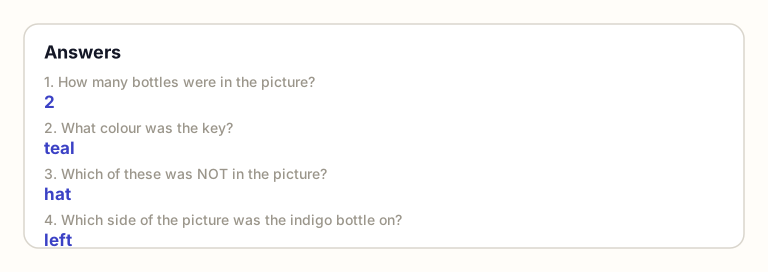
1. How many bottles were in the picture? — 2. The scene contains 2 objects of that kind. 2. What colour was the key? — teal. The key in the scene is teal. 3. Which of these was NOT in the picture? — hat. No object of that kind appears in the object list for this scene. 4. Which side of the picture was the indigo bottle on? — left. Its horizontal position is 175 of 720, which puts it on the left.
Read next
Five Differences Hidden in This Garden Scene
Two illustrated garden scenes built from the same source data, with a recorded list of deliberate changes. The difference count is exact, not approximate.
 Find It
 There Is One 8 Hidden Among the 3s. How Fast Can You Find It?
A grid of repeated characters with exactly one impostor at known coordinates. Easy to describe, considerably harder to do than it sounds.
 Odd One Out
 The Harder Version: A Hundred Symbols, One Difference
A ten by ten grid where one symbol has been altered by a single small change. Considerably harder than the arrow version, and still guaranteed to have exactly one answer.