
Twelve Things You Have Heard All Your Life. How Many Are Actually True?
Twelve claims that everybody repeats, checked one at a time. Four are true, five are false, and three are the interesting answer: partly.

Almost everybody carries a store of received facts absorbed in childhood and never examined since. Some are correct, some are not, and a surprising number sit in between.
The in-between cases are the most interesting, because they show how claims survive: a real effect gets exaggerated, a specific finding gets generalised, or a plausible mechanism gets attached to an unrelated observation.
Twelve of them below, counting up to the one that explains the whole genre.
-
Number 12: TRUE — Red sky at night is a genuine, if rough, forecast

NASA/JPL/Texas A M/Cornell — Public domain — Wikimedia Commons In mid-latitudes weather systems generally move from west to east. A red sky at sunset means the setting sun in the west is shining through relatively clear air, suggesting the approaching weather may be settled. It is a rough rule of thumb rather than a forecast, and it does not transfer to regions with different prevailing wind patterns.
-
Number 11: FALSE — Bulls are enraged by the colour red

Steer Photographic — CC BY 2.0 — Wikimedia Commons Cattle are dichromats and do not perceive red the way humans do. What provokes the animal in a bullring is the movement of the cape, not its colour, which has been demonstrated by simply using capes of other colours.
-
Number 10: PARTLY — You lose most of your body heat through your head
Illustration: World of Curious You lose heat roughly in proportion to exposed surface area. The head is a substantial area and is often the only part uncovered, so in practice a hat helps a great deal. The specific claims about a fixed large percentage appear to derive from a badly designed study and are not supported.
-
Number 9: FALSE — Cracking your knuckles causes arthritis

Goudieman — CC0 — Wikimedia Commons The sound is generally attributed to a gas bubble forming or collapsing in the joint fluid. Studies looking for a link with arthritis, including one researcher who cracked the knuckles on one hand only for decades, have not found one.
-
Number 8: TRUE — Lightning strikes the same place repeatedly

Photo by Hallie Larsen, National Park Service — Public domain — Wikimedia Commons Tall, isolated, conductive structures are struck many times a year. The saying is simply wrong, and lightning protection engineering is designed around the assumption that it is wrong.
-
Number 7: FALSE — Goldfish have a three-second memory

Childe Hassam — Public domain — Wikimedia Commons Fish have been trained in experiments to respond to signals and to navigate mazes, with retention over periods of weeks and months. The three-second claim has no evidential basis.
-
Number 6: PARTLY — Chewing gum stays in your stomach for years

Alf van Beem — CC0 — Wikimedia Commons The base is not digestible, which is the true part. It passes through the digestive system in the ordinary way over a normal timescale rather than accumulating. The years-long version is folklore.
-
Number 5: TRUE — Honey can keep almost indefinitely

Alabama Extension — CC0 — Wikimedia Commons Honey is very low in water and mildly acidic, which makes it inhospitable to the organisms that spoil food. Sealed honey found in ancient contexts has been reported as unspoiled. Once opened and exposed to moisture it can ferment, so the claim needs the sealed condition attached.
-
Number 4: FALSE — Different parts of the tongue detect different tastes
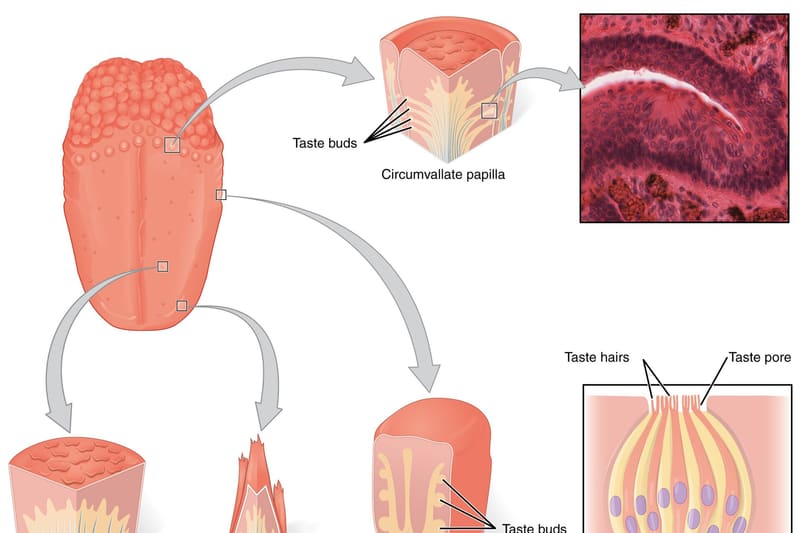
OpenStax — CC BY 4.0 — Wikimedia Commons The tongue map appears in a great many textbooks and comes from a mistranslation and over-interpretation of early research. Taste receptors for all basic tastes are distributed across the tongue, with only modest variation in sensitivity.
-
Number 3: PARTLY — Sugar makes children hyperactive

carol — Public domain — Wikimedia Commons Controlled trials, including double-blind studies where parents did not know whether their child had been given sugar, have generally found no effect on behaviour. What has been demonstrated is that parents who believe their child has had sugar rate the same behaviour as more hyperactive. The occasions are usually parties, which are themselves exciting.
-
Number 2: TRUE — Your fingerprints are effectively unique, including identical twins
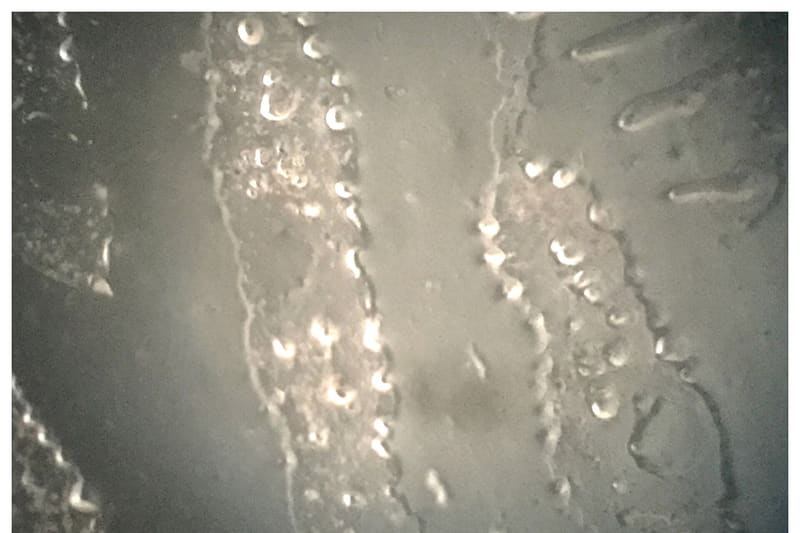
ConformationXII — CC BY-SA 4.0 — Wikimedia Commons Fingerprint patterns form in the womb and are influenced by physical conditions during development, not by genetics alone. Identical twins share DNA and do not share fingerprints, which is one of the clearest everyday demonstrations that genes are not the whole story.
-
And the strangest one of the lot
Number 1: FALSE, AND THE MOST REVEALING — The five-second rule
Illustration: World of Curious Bacterial transfer from a surface to dropped food begins immediately. Studies have found that contact time does affect how much transfers, so food picked up faster does pick up less — but there is no threshold below which nothing happens, and the type of food and surface matter far more than the time. Wet food on a hard surface picks up substantially more than dry food on carpet. The reason this one is the most interesting entry is that it shows how a myth survives: it contains a grain of truth, it is easy to test informally, the consequences of being wrong are usually invisible, and everybody wants it to be true. That combination is exactly what keeps a false claim alive for generations.


.png)


The three partly answers are the ones worth remembering. A great many popular claims are neither true nor false but true under conditions nobody mentions.
Editor's note: General interest writing, not medical advice. Where a claim concerns your own health, a clinician is a better source than any website.
Where this came from
- Health information and common health myths — NHS
- Science and nature reference — Encyclopaedia Britannica
- Weather lore and forecasting — Met Office
Read next
 Real or Fake
 Real or Fake? Ten Scientific Claims, and Only Some Are True
Ten claims about physics, chemistry and biology. Some are established findings that sound absurd; some are things everybody repeats that are simply wrong.
 Explainer
 Ten Everyday Questions With Surprisingly Good Answers
Why metal feels colder than wood, why the sky changes colour, why ice is slippery and six more. Plain explanations, including where the honest answer is that it is complicated.
 Myth or Fact
 Eight Famous Film Production Stories, and Which Ones Hold Up
Film sets generate legends faster than any other workplace. Eight of the most repeated stories, sorted into the documented, the disputed and the invented.