
Number Puzzles Number Sequence
What Comes Next? A Sequence With Exactly One Rule
Most sequence puzzles are broken, because several answers fit. This one is generated from a single stated rule, and a validator recalculates the answer independently.
Number sequences have a bad reputation, and they have earned it.
The problem is mathematical rather than editorial. For any finite list of numbers, there is an infinite number of rules that produce it, so a sequence puzzle is only fair if the intended rule is clearly the simplest one available and if enough terms are shown to make it obvious.
Plenty of published sequence puzzles fail that test. They show four terms, accept one answer, and have at least two defensible alternatives.
How this one is built
Every sequence on this site is generated the other way round. A rule object is chosen first — arithmetic, geometric, alternating, squares, triangular numbers, a simple recurrence — and the terms are then produced from it.
Six terms are shown, which is enough to pin down the family of simple rules. Before it can publish, a validator rebuilds the entire series from the stored rule through a separate function, compares it term by term with what is on the page, and checks that the recomputed next value matches the stored answer. It also rejects any sequence that repeats a term, because a repeat usually means an accidental fixed point and an ambiguous rule.
If you get stuck
Write the gaps down. Under each pair of adjacent numbers, write the difference between them. If those differences are all the same, it is arithmetic and you are finished.
If the differences are not constant, look at the differences between the differences. A constant second difference means the sequence grows in a regular quadratic way, which usually points at squares or triangular numbers.
If neither works, try division rather than subtraction. A constant ratio means it is geometric.
The reveal below gives the answer and states the rule in plain words.
Medium What number comes next in this sequence?

Reveal the answer
Answer 47
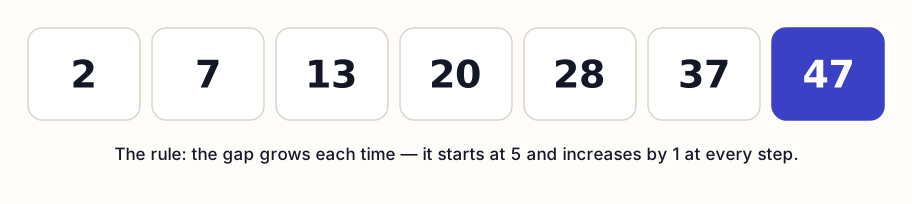
The answer is 47, because the gap grows each time — it starts at 5 and increases by 1 at every step. Applying that to the last visible term, 37, gives 47.
Read next
 Logic Puzzle
 Four Clues, One Queue: Can You Work Out the Order?
A short ordering puzzle with a single provable answer. Every clue is needed, and a solver checks that only one arrangement fits before it is published.
 Puzzle
 This Matchstick Equation Is Wrong. Move One Stick to Fix It
A matchstick puzzle with exactly one solution, found by searching every legal single-stick move before publication. Ambiguous matchstick puzzles are the most common broken puzzle online.
 Visual Sequence
 Which Shape Comes Next? Four Panels and One Rule
A visual sequence where a single transformation is applied at every step. The fifth panel is computed from the rule, not chosen, so exactly one of the four options can be right.