
Optical Illusions Explainer
Seven Classic Illusions, and What Your Eyes Are Actually Doing
The famous illusions explained without overstating what the science shows: what is well established, what is still argued about, and what the brain is really up to.
The useful thing about optical illusions is not that they trick you. It is that they show you the shortcuts your visual system is taking all the time, on everything you look at, without asking.
Vision is not a recording. The eye delivers a noisy, low-resolution, upside-down, partly blind stream of data, and the brain constructs a stable scene out of it using a set of assumptions about how the world usually behaves. Illusions are simply images that break those assumptions.
Here are seven of the classics, with what is actually known about each.
1. The two lines that are the same length
Two horizontal lines of identical length, one with arrowheads pointing outwards at each end, one with them pointing inwards. The second looks shorter. Every time.
The most common explanation is that the arrowheads resemble the corners of a room or a building — a near corner versus a far corner — and the visual system adjusts apparent size to account for apparent distance. There is evidence for this, but the illusion also works on people from environments with very few right-angled buildings, so the full story is still debated. Measure them.


2. The grey squares that are the same grey
Two patches printed in identical ink, one surrounded by dark, one by light. The one on the dark background looks lighter.
This one is not controversial at all. The visual system cares about contrast, not absolute brightness, because absolute brightness tells you almost nothing useful — a sheet of white paper indoors reflects less light than a lump of coal in sunlight. Judging surfaces by comparison with their surroundings is the only way to recognise a white object as white in both situations.
3. The grid where grey blobs appear at the crossings
Look at a grid of white lines on a black field, and faint dark smudges seem to flicker at the intersections, always in the corner of your eye, never where you are looking directly.


The traditional textbook explanation involves the way neighbouring retinal cells inhibit each other. That account has been seriously challenged, because the effect disappears if the lines are made wavy rather than straight, which the simple version does not predict. It is a genuinely open question, and a good example of a “solved” illusion that was not.
4. The impossible triangle
Three bars that appear to form a closed triangle with every corner at a right angle, which cannot exist.
Nothing is wrong with the drawing. The visual system interprets each junction locally and correctly, then assembles those local readings into a whole without checking that the whole is consistent. The illusion exposes something real about how perception is built: from parts, fast, without a final proofread.


5. The face that is also something else
Ambiguous figures — a vase or two profiles, a young woman or an old one — flip between readings and refuse to settle.
The interesting part is the refusal. You cannot see both at once, and you cannot easily hold one indefinitely. Perception commits to a single interpretation, and when the evidence supports two equally, it alternates rather than blending them.
6. The moon that looks bigger near the horizon
A famous one, and worth a caution: it is not caused by the atmosphere magnifying anything. The moon measures the same on the horizon as it does overhead, and you can check this with a camera.


The explanation is perceptual and, after more than a thousand years of discussion, still not settled. Most accounts involve the fact that the horizon gives the visual system distance cues — buildings, hills, trees — that the empty sky does not.
7. Colours that change with the light around them
The famous photograph of a dress that some people saw as blue and black and others as white and gold is the modern example, but the effect is ordinary.
Your visual system is constantly correcting for the colour of the light source so that a white shirt looks white at sunset and under a fluorescent tube. When an image gives ambiguous cues about what kind of light is falling on a scene, different people’s systems make different assumptions, and both see something perfectly consistent with their own correction.

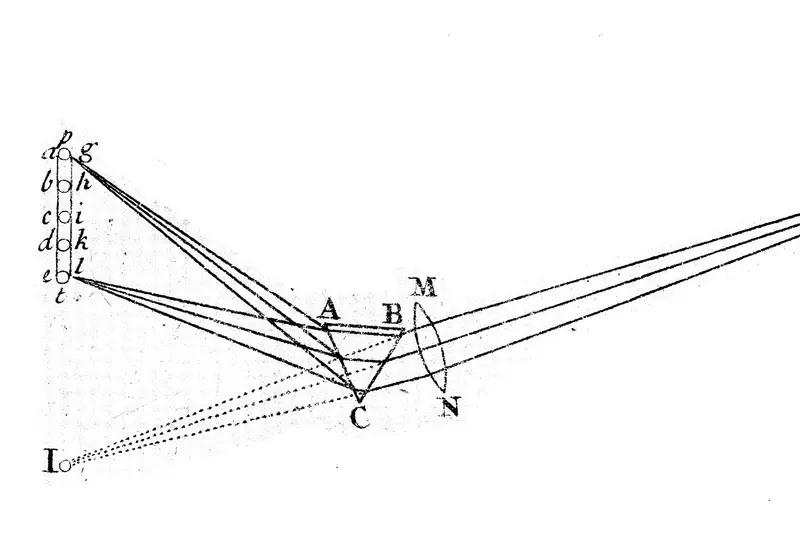
.jpg)
What none of this means
Illusions do not reveal your personality, your intelligence or the state of your brain. They are properties of the image and of normal human vision, and essentially everyone with typical sight experiences them.
Anyone telling you that what you see first in a picture says something about your character is selling something.
Where this came from
- Vision and perception collections — Science Museum Group
- How the eye works — Royal National Institute of Blind People
- Research on visual perception and illusion — Encyclopaedia Britannica

Read next
 Odd One Out
 One Arrow in This Grid Is Pointing the Wrong Way. Can You Find It?
A grid of identical arrows with exactly one impostor. The answer is generated from the puzzle data before the picture is drawn, so there is no argument about where it is.
 Explainer
 Ten Everyday Questions With Surprisingly Good Answers
Why metal feels colder than wood, why the sky changes colour, why ice is slippery and six more. Plain explanations, including where the honest answer is that it is complicated.
 Logic Puzzle
 Four Clues, One Queue: Can You Work Out the Order?
A short ordering puzzle with a single provable answer. Every clue is needed, and a solver checks that only one arrangement fits before it is published.