
Space Weirdness Countdown
Eight Places in the Solar System With Genuinely Bizarre Weather
Sideways glass rain, a storm older than photography, and a moon with rivers of methane. Eight places where the weather report would be unprintable.

Weather needs three things: an atmosphere, an energy source, and rotation. Change any of them and you get results that look absurd from here.
The solar system is full of that. The temperature ranges are wider, the pressures are more extreme, and the chemistry is unfamiliar — which is how you end up with rain that is not water and storms older than photography.
Eight of them, counting up to the one that is hardest to picture.
-
Number 8: Venus: a surface hot enough to melt lead
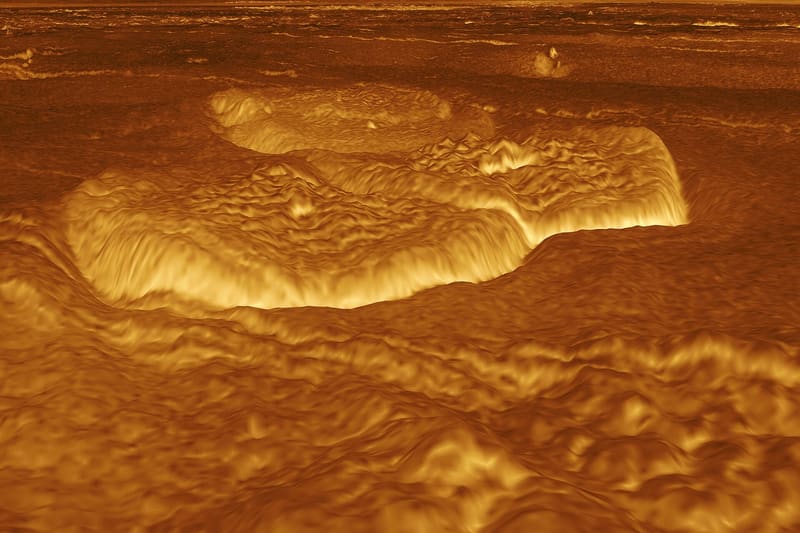
NASA, JPL Multimission Image Processing Laboratory, U.S Geological — Public domain — Wikimedia Commons Around 465 degrees Celsius at the surface, with atmospheric pressure roughly ninety times Earth's — comparable to being about 900 metres underwater. The heat is not mainly because Venus is closer to the Sun; it is a runaway greenhouse effect in a thick carbon dioxide atmosphere.
-
Number 7: Mars: dust storms that can cover the planet
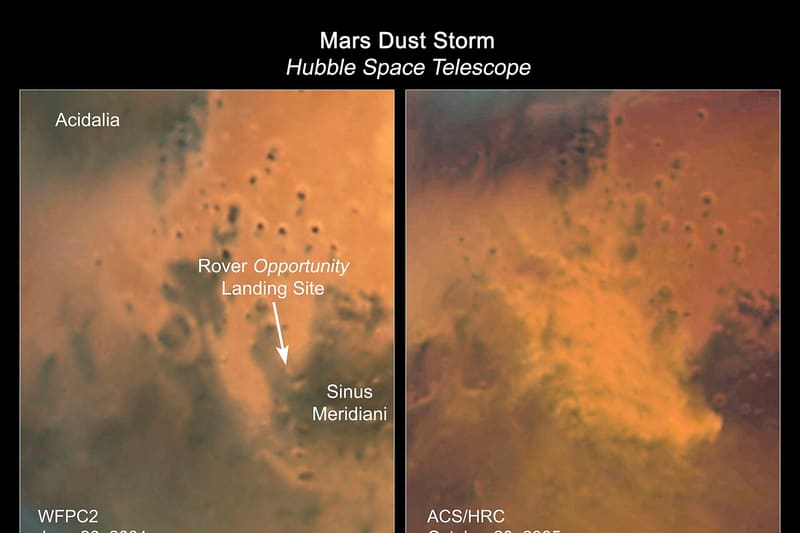
NASA , ESA , The Hubble Heritage Team ( STScI / AURA ), J. Bell — Public domain — Wikimedia Commons Regional storms occasionally grow until they encircle Mars entirely and can last for weeks. They are not the howling gales of film — the atmosphere is so thin that the wind carries very little force — but they block enough sunlight to end solar-powered missions.
-
Number 6: Jupiter: a storm that has been watched for centuries
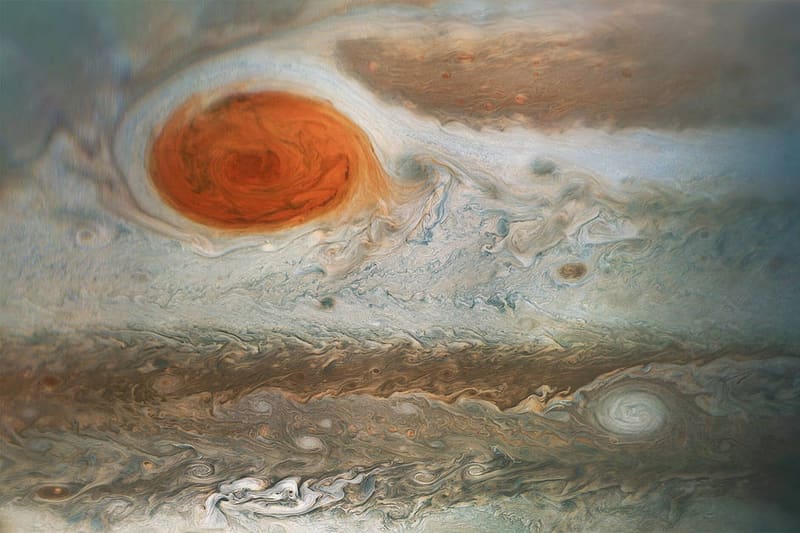
NASA/JPL-Caltech/SwRI/MSSS/Gerald Eichstädt/Seán Doran — Public domain — Wikimedia Commons The Great Red Spot is an anticyclone wide enough to swallow Earth. Astronomers have been observing a prominent spot on Jupiter since at least the nineteenth century, and probably since the seventeenth. It has been measurably shrinking in recent decades.
-
Number 5: Saturn: a hexagonal jet stream at the north pole
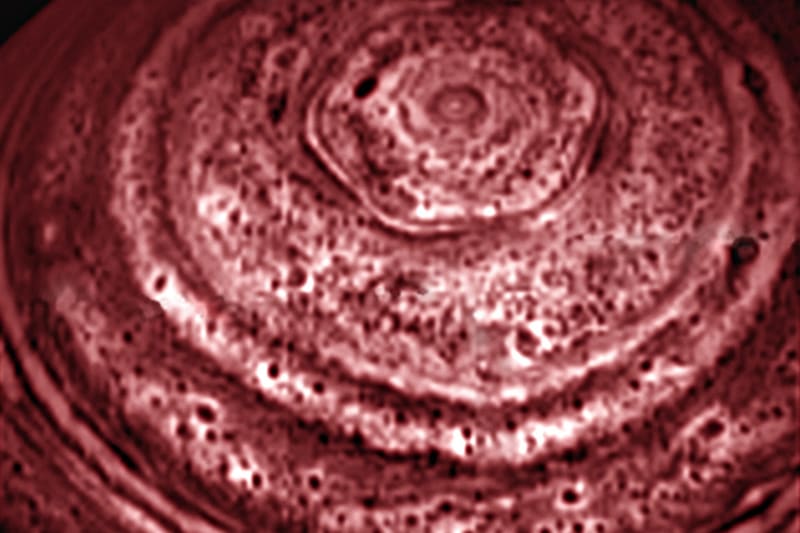
NASA / Jet Propulsion Lab / University of Arizona — Public domain — Wikimedia Commons A persistent six-sided cloud pattern thousands of kilometres across, first seen by Voyager and studied in detail by Cassini. Laboratory experiments with rotating fluids can produce similar polygonal shapes, which is the leading explanation.
-
Number 4: Uranus: a planet tipped on its side
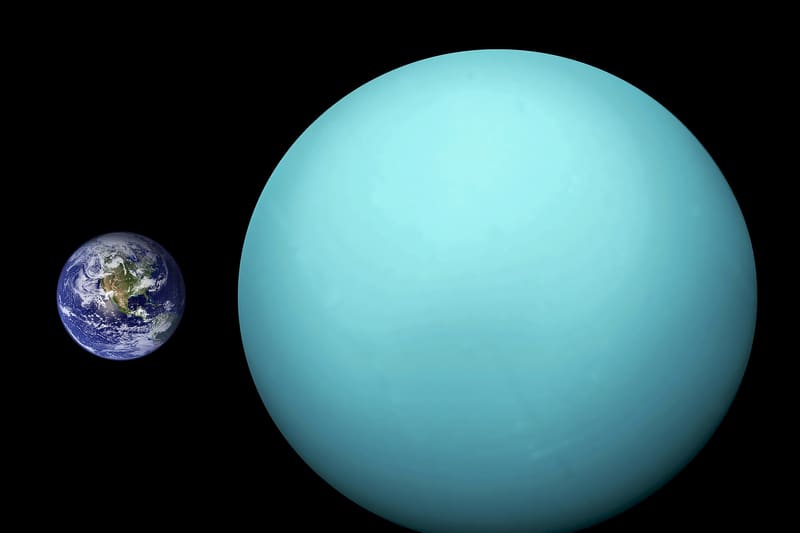
Orange-kun (old version user: Brian0918 ) — Public domain — Wikimedia Commons Its axis is tilted by about 98 degrees, so it effectively rolls around the Sun. That produces seasons lasting roughly twenty years each, with one pole in continuous sunlight while the other is in continuous darkness.
-
Number 3: Neptune: the fastest winds measured anywhere
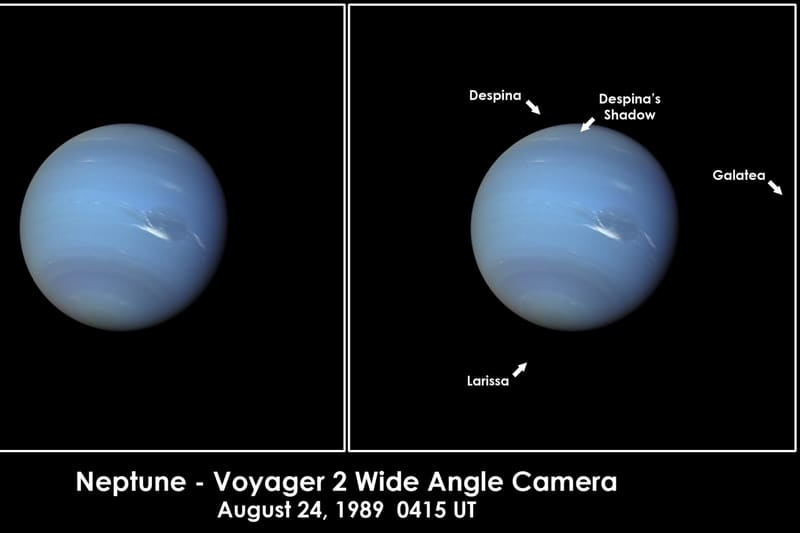
Justin Cowart — Public domain — Wikimedia Commons Wind speeds in Neptune's atmosphere have been measured at around 2,000 kilometres per hour. What makes this odd is that Neptune receives very little sunlight, so the usual energy source for driving weather is largely absent.
-
Number 2: Titan: rivers and lakes, but not of water
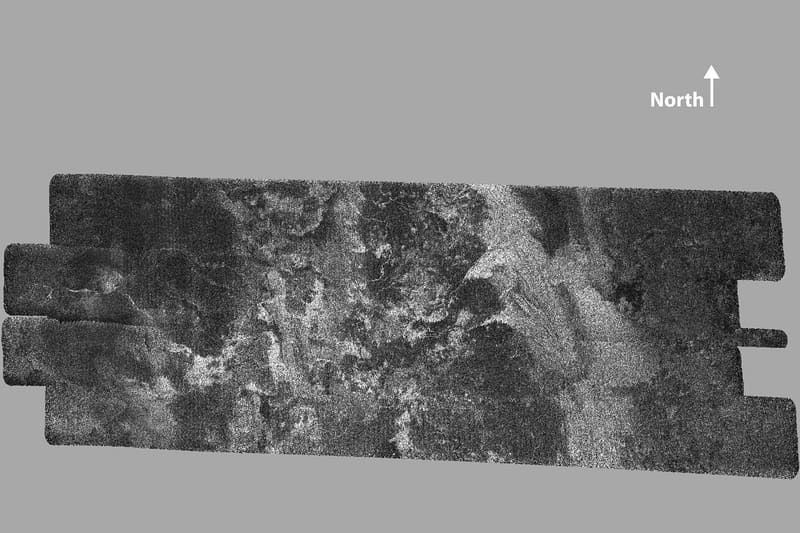
NASA/JPL — Public domain — Wikimedia Commons Saturn's largest moon has a thick nitrogen atmosphere, clouds, rain, rivers and seas — all made of liquid methane and ethane, at around minus 180 degrees Celsius. The Cassini mission mapped the seas from orbit, and the Huygens probe landed on the surface in 2005.
-
And the strangest one of the lot
Number 1: HD 189733 b: sideways glass rain
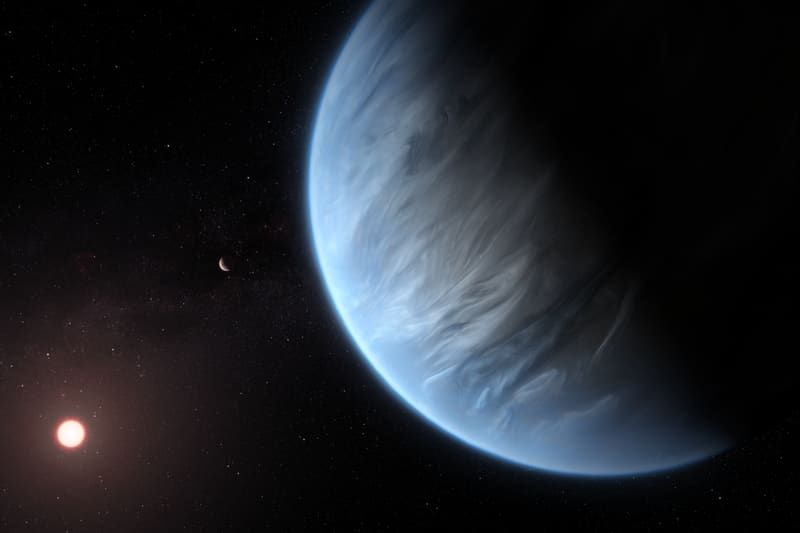
/Hubble, M. Kornmesser — Public domain — Wikimedia Commons This one is outside the solar system, and it earns its place. It is a gas giant orbiting extremely close to its star, with an atmosphere estimated at around 1,000 degrees Celsius and winds modelled at several thousand kilometres per hour. Its deep blue colour is thought to come from silicate particles in the atmosphere — which, at those temperatures and speeds, means something close to molten glass being driven horizontally at enormous velocity. The detail comes from modelling and spectroscopy rather than direct observation, and researchers are careful to say so, but it remains the most spectacular weather forecast in astronomy.


.jpg)


.png)

.png)
Almost everything on this list was unknown a lifetime ago. Most of it comes from a handful of missions that were never certain to work.
Where this came from
- Solar system exploration: planets and moons — NASA
- Cassini mission findings at Titan and Saturn — NASA Jet Propulsion Laboratory
- Planetary science overviews — European Space Agency
Read next
 Countdown
 Ten Things Your Body Does Constantly That You Never Notice
Reflexes, corrections and background processes that run without you: ten of them explained in plain language, with no medical advice attached.
 Countdown
 Nine Deep-Sea Creatures That Barely Look Real
The deep ocean is the largest habitat on Earth and the least visited. Nine of its residents, and the specific problem each one has evolved to solve.
 Real or Fake
 Real or Fake? Ten Scientific Claims, and Only Some Are True
Ten claims about physics, chemistry and biology. Some are established findings that sound absurd; some are things everybody repeats that are simply wrong.