
Strange Places on Earth Countdown
Eight Landscapes That Look Edited and Are Not
Pink lakes, striped mountains and ground that has been burning for decades. Eight places that look impossible, with the geology that explains each one.

Photographs of these places get accused of being edited, which is fair enough — several of them do look like a colour slider pushed too far.
They are not. Every one has a mechanism behind it, and the mechanisms are almost always mundane: minerals, microbes, cooling rates, erosion. The strangeness comes from scale and duration rather than from anything exotic.
Eight of them, counting up to the one that is hardest to picture.
-
Number 8: Lakes that are genuinely pink
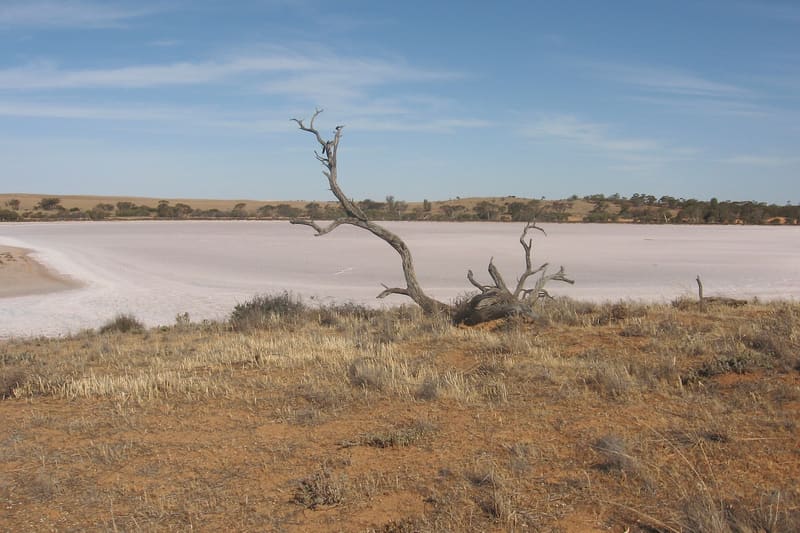
Papphase — Public domain — Wikimedia Commons Several salt lakes around the world turn vivid pink, including examples in Western Australia. The colour comes from micro-organisms and algae that thrive in extremely salty water and produce red and orange pigments. Salinity, temperature and light all affect how strong the colour is, so the same lake can look ordinary at other times of year.
-
Number 7: Mountains with horizontal coloured stripes
Illustration: World of Curious Layered sedimentary rock, laid down over millions of years with different mineral content in each layer, then tilted and eroded. The stripes are the edges of the layers. Iron compounds do most of the colouring — reds and yellows from oxidised iron, greens and greys from other minerals.
-
Number 6: A field of stone spheres
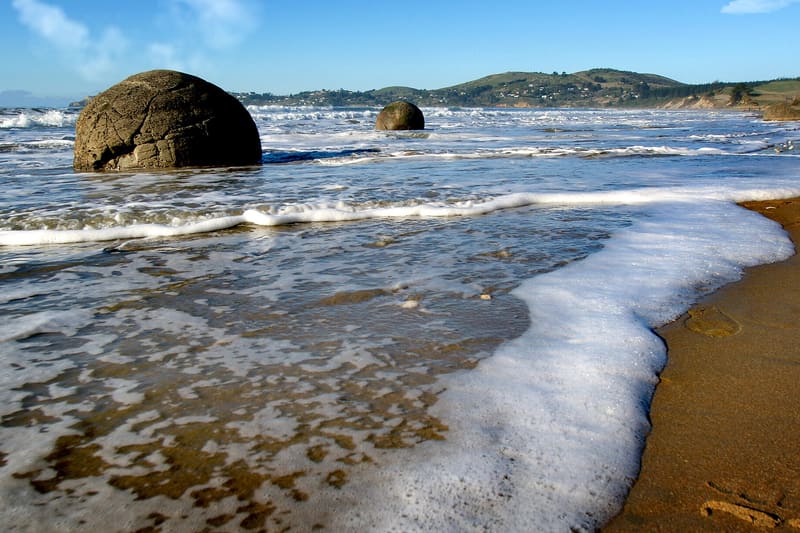
Bernard Spragg. NZ from Christchurch, New Zealand — CC0 — Wikimedia Commons Almost perfectly round boulders occur in several places, formed as concretions: mineral deposits that build up in concentric layers around a nucleus inside soft sediment. When the softer surrounding rock erodes away, the spheres are left behind.
-
Number 5: Ground that has been on fire for decades
Illustration: World of Curious Underground coal seam fires can burn for extraordinary lengths of time, fed by oxygen through cracks in the surface. Some have been alight for many decades and have made entire settlements uninhabitable. A few natural gas seeps have reportedly burned for far longer.
-
Number 4: Columns of hexagonal rock
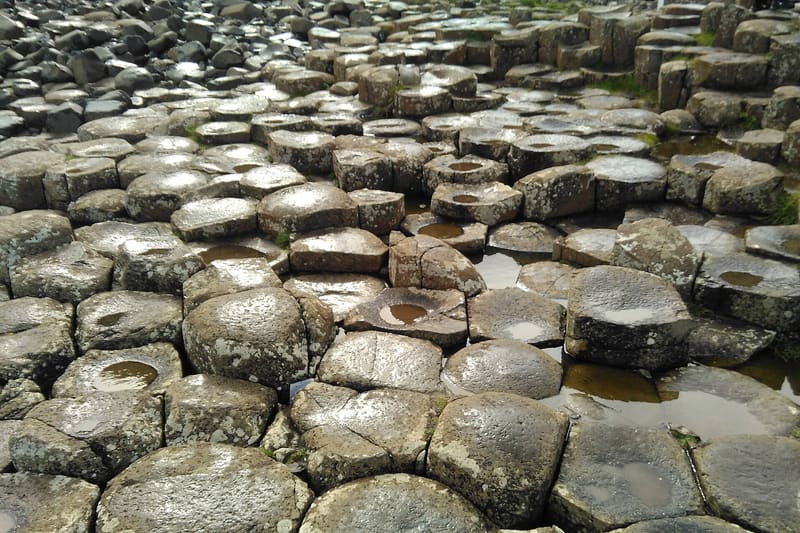
DeveshT — CC0 — Wikimedia Commons When a thick lava flow cools slowly and evenly, it contracts and cracks, and the most efficient crack pattern is close to hexagonal. The result is fields of regular columns that look carved. The same pattern turns up in drying mud on a much smaller scale.
-
Number 3: A waterfall that appears to run underwater
Illustration: World of Curious An optical effect caused by sand and sediment being carried off the edge of a shallow shelf into a deep ocean trench. Nothing is falling in the way it looks; the sand is being moved by currents down a steep underwater slope.
-
Number 2: Salt flats that turn into a mirror
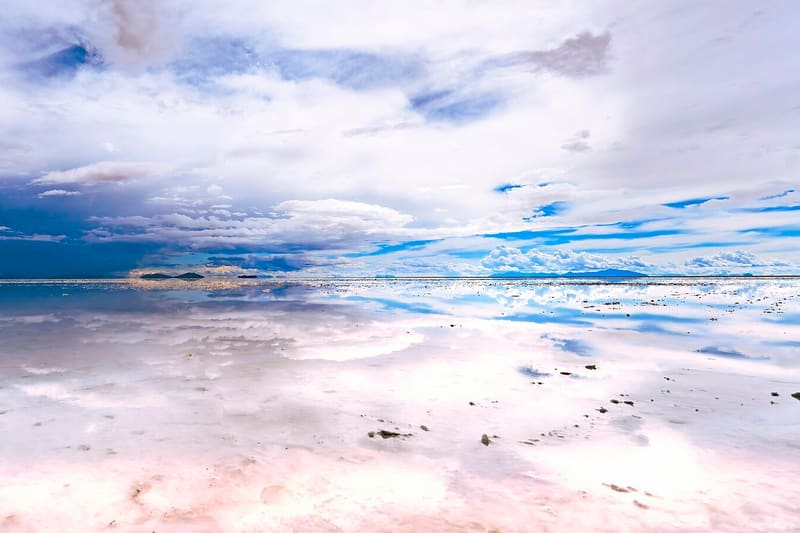
Abel Maestro Garcia — Public domain — Wikimedia Commons After rain, a thin layer of water sits on a perfectly flat salt pan with nowhere to drain. The result reflects the sky so completely that the horizon disappears. The flatness is the unusual part: some of these surfaces vary by less than a metre across enormous distances.
-
And the strangest one of the lot
Number 1: A river running through a canyon it is older than
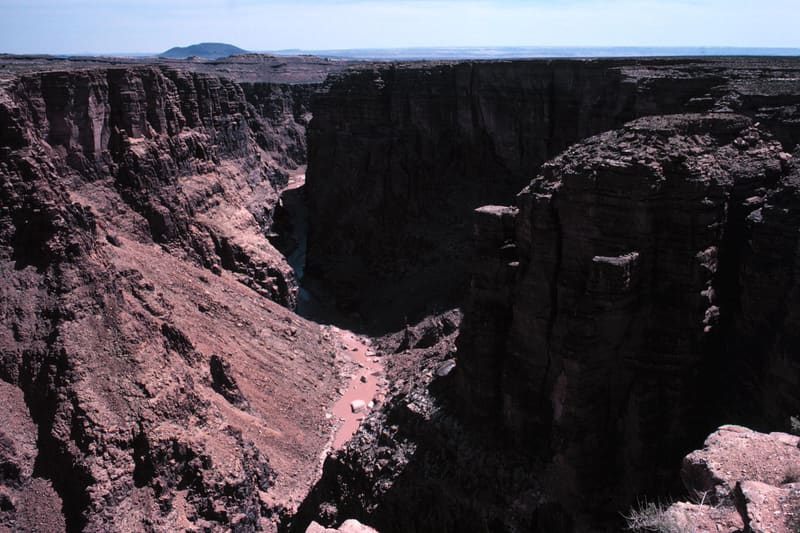
Joseph H. Hartman — CC0 — Wikimedia Commons This is the one that takes a moment. In several places a river cuts straight through a mountain range rather than going around it, which looks impossible — water does not climb. The explanation is time. The river was there first, running across a flat plain. The land then rose slowly beneath it, and the river kept cutting downwards at roughly the same rate as the uplift, holding its course while a mountain range grew around it. The canyon is not a channel the river found. It is one the river maintained while the world moved.


.jpg)

,_Bolivia,_12-2022_1.jpg)
.jpg)
Almost every landscape that looks impossible is the result of a very ordinary process running for an unreasonable length of time.
Where this came from
- Geology and landforms reference — United States Geological Survey
- Earth sciences collections and research — Natural History Museum
- World heritage and natural sites — UNESCO
Read next
 Countdown
 Ten Plants and Fungi With Genuinely Ruthless Strategies
Plants are not passive. Ten species that trap, poison, strangle, hijack or outlive everything around them, with the mechanism explained for each.
 Countdown
 Nine Deep-Sea Creatures That Barely Look Real
The deep ocean is the largest habitat on Earth and the least visited. Nine of its residents, and the specific problem each one has evolved to solve.
 Countdown
 Eight Places in the Solar System With Genuinely Bizarre Weather
Sideways glass rain, a storm older than photography, and a moon with rivers of methane. Eight places where the weather report would be unprintable.